Big Data Management: Improving Business Efficiency and Performance
Introduction
Data has become one of the most valuable business assets in the modern world. Every customer interaction, online transaction, website visit, and operational process generates information that can help organizations make better decisions. However, collecting information is only the beginning. Without effective big data management, businesses often find themselves overwhelmed by growing volumes of data that are difficult to organize, analyze, and use effectively.
The challenge is not simply dealing with large amounts of information. Companies must manage data coming from multiple sources, formats, and systems while maintaining accuracy, security, and accessibility. As organizations continue to expand their digital operations, poor data management can lead to inefficiencies, rising costs, delayed decision-making, and missed opportunities.
Businesses that treat data as a strategic asset gain a significant competitive advantage. They can identify trends faster, improve customer experiences, optimize operations, and make more informed decisions. This guide explores the foundations of big data management, the challenges organizations face, and the strategies that help transform raw information into meaningful business value.
Why Big Data Management Matters More Than Ever
Too many organizations think that the more data they have, the better business results they will get. Unfortunately, unmanaged data often causes more issues than solutions.
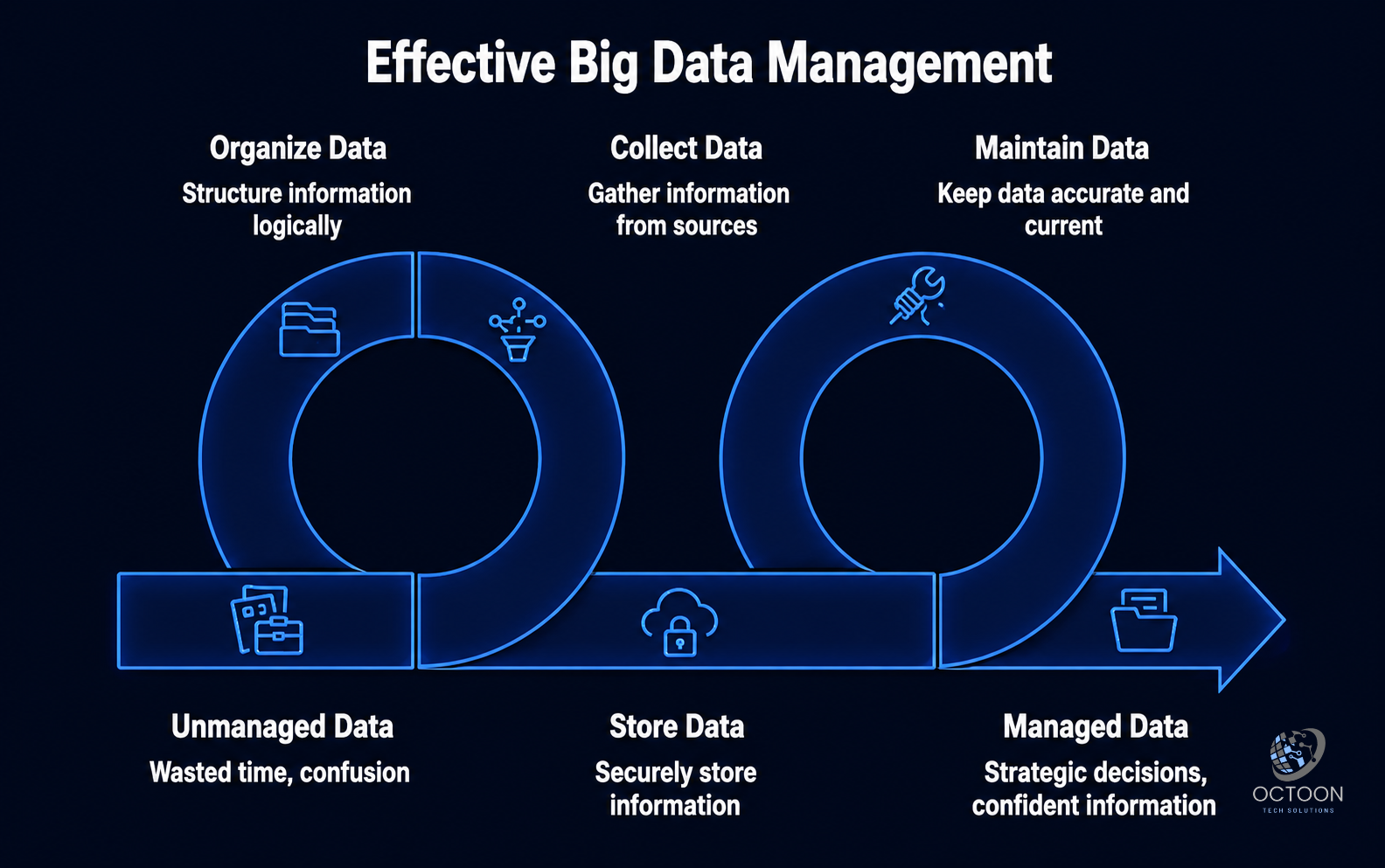
Having information spread across departments, applications, and platforms wastes teams' time in finding it before they can use it. Additional inefficiencies and confusion throughout the organization can also occur because of the duplication of data, format issues, and obsolete data.
Big data Analytics offers a structured way of collecting, organizing, storing, and maintaining information to be useful and accessible. It helps businesses be confident in the information they have and can leverage to make strategic decisions.
With the growing dependence of businesses on digital systems, the need for effective data management is also rising. Without good data practices, organizations can find scalability, compliance, and operational performance issues difficult.
Understanding the Growing Complexity of Modern Data
A decade ago, the businesses were dealing with structured information in traditional database systems. The view is quite different today.
Data is gathered from websites, mobile apps, social media, the cloud, IoT devices, customer support, and enterprise software. There are multiple information sources of various formats and quantities.
This is where the difference between structured & unstructured data comes in.
Structured data is data that is organized in a specific structure and can be easily stored in tables and databases. They include common data such as customer records, transaction histories, and inventory data.
However, unstructured data includes emails, videos, images, documents, chat conversations, and social media posts. This information has great tips, but it's not as easy to process and analyze.
In the current digital age, every business must manage both categories of data effectively to gain a comprehensive understanding of its operations and clientele.
The Foundation of Effective Data Architecture
It is essential to have a solid data architecture to enable the successful management of big data.
Consider data architecture as the blueprint for the flow of information across an organisation. It specifies the source of data, the way this is processed, where it is stored, and how it is accessed by users.
Businesses without their own architecture build separate systems, which make data tough to handle. Departments will have information stored in their own systems, resulting in data duplication, inconsistencies, and reporting issues.
A good data architecture provides a unified structure that is scalable, accessible, and reliable. It ensures consistency of information from where it is collected to where it is used.
More importantly, good architecture enables the organization to evolve as the volume of data expands and the organization's business needs change.
How Database Systems Support Business Performance
In any data management plan, database systems are a fundamental part.
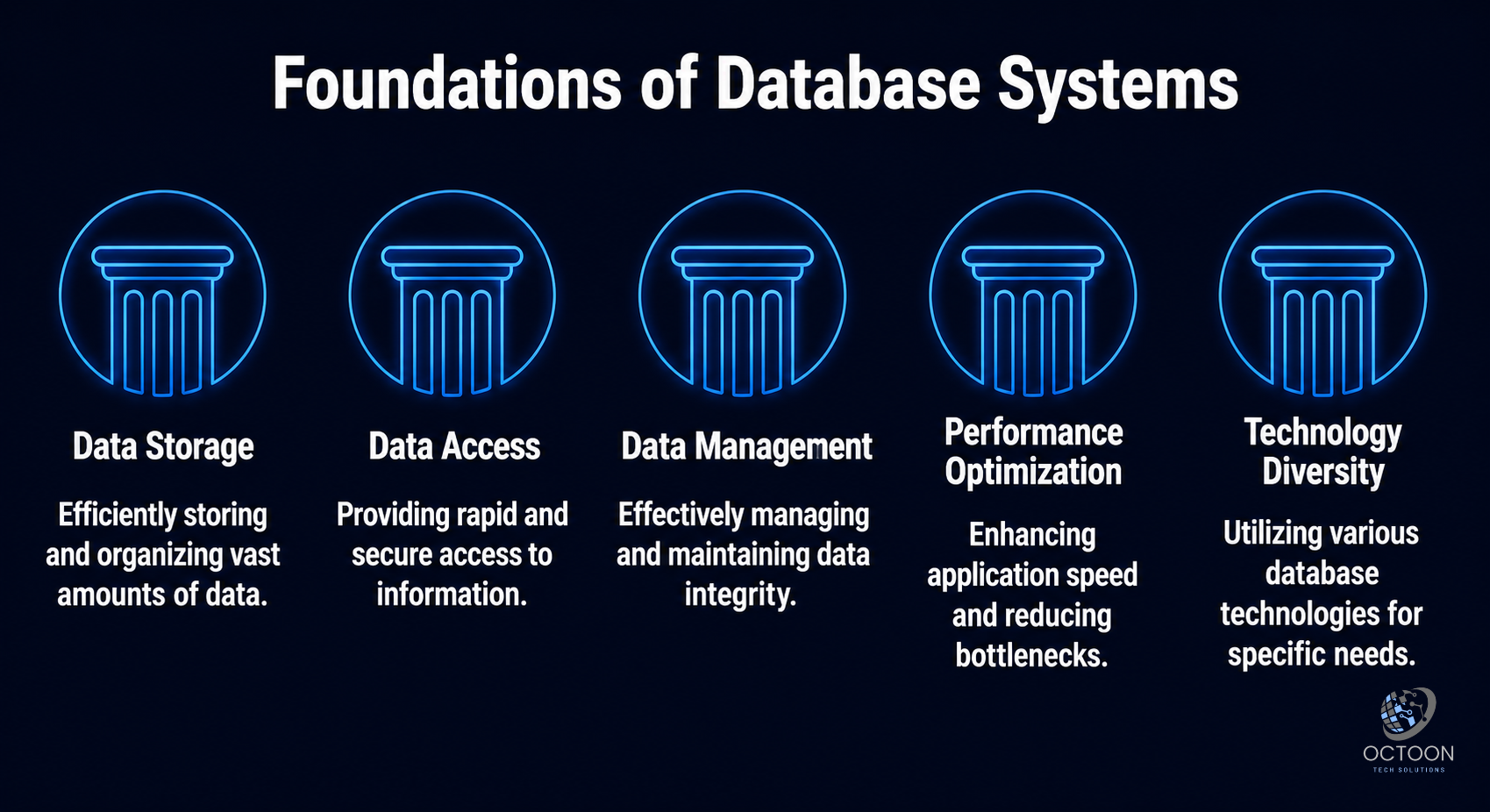
They offer the framework for storing, accessing, and managing data efficiently. For any small application or a global enterprise platform, database performance makes a difference in the efficiency of the application.
A poorly optimized database can make applications slower, reporting slower, and can cause performance bottlenecks that affect productivity.
Depending on the need and the environment, modern businesses can make use of an array of different database technologies. While traditional relational databases are useful for structured information, newer technologies are effective at handling large-scale analytics and data in a variety of formats.
Data analytics as a service is not just about storing information; it is about ensuring that access to that information is provided quickly, securely, and accurately whenever needed.
Companies with strong database systems tend to have quicker decision-making processes, better operational efficiency, and scalability.
Why ETL Processes Are Essential for Data Integration
A major challenge for organizations is to harmonize data from various sources.
Customer data could be in a CRM, financial info in accounting software, and operational data in separate enterprise systems. Without integration, it is hard to get a full picture.
That's where ETL processes are needed.
ETL is an acronym for Extract, Transform, and Load.
The first step in the process is to gather information from various sources. That data is then converted to a standardized format, which is then stored in a central system for analysis and reporting.
Good ETL processes remove data errors and provide consistency in information throughout the enterprise.
They also enable sophisticated analytics by delivering decision makers the ability to analyze and make decisions based on accurate, coherent data, not disjointed information across different systems.
With businesses increasingly using digital tools, efficient ETL workflows are more crucial than ever to keep the business visible.
The Hidden Cost of Poor Data Quality
Several organizations spend significant time and money on analytics tools, but they fail to realize that there is a basic problem with data quality.
The best analytics system will not provide accurate information when the data is incorrect.
Business intelligence efforts can be severely diminished by the lack of completeness, by duplicate records, by out-of-date information, and by inconsistent formatting.
Hence, data cleansing is an important aspect in big data management.
Data cleansing is the process of using data quality tools to detect and fix errors in data sets to ensure that they are accurate and consistent.
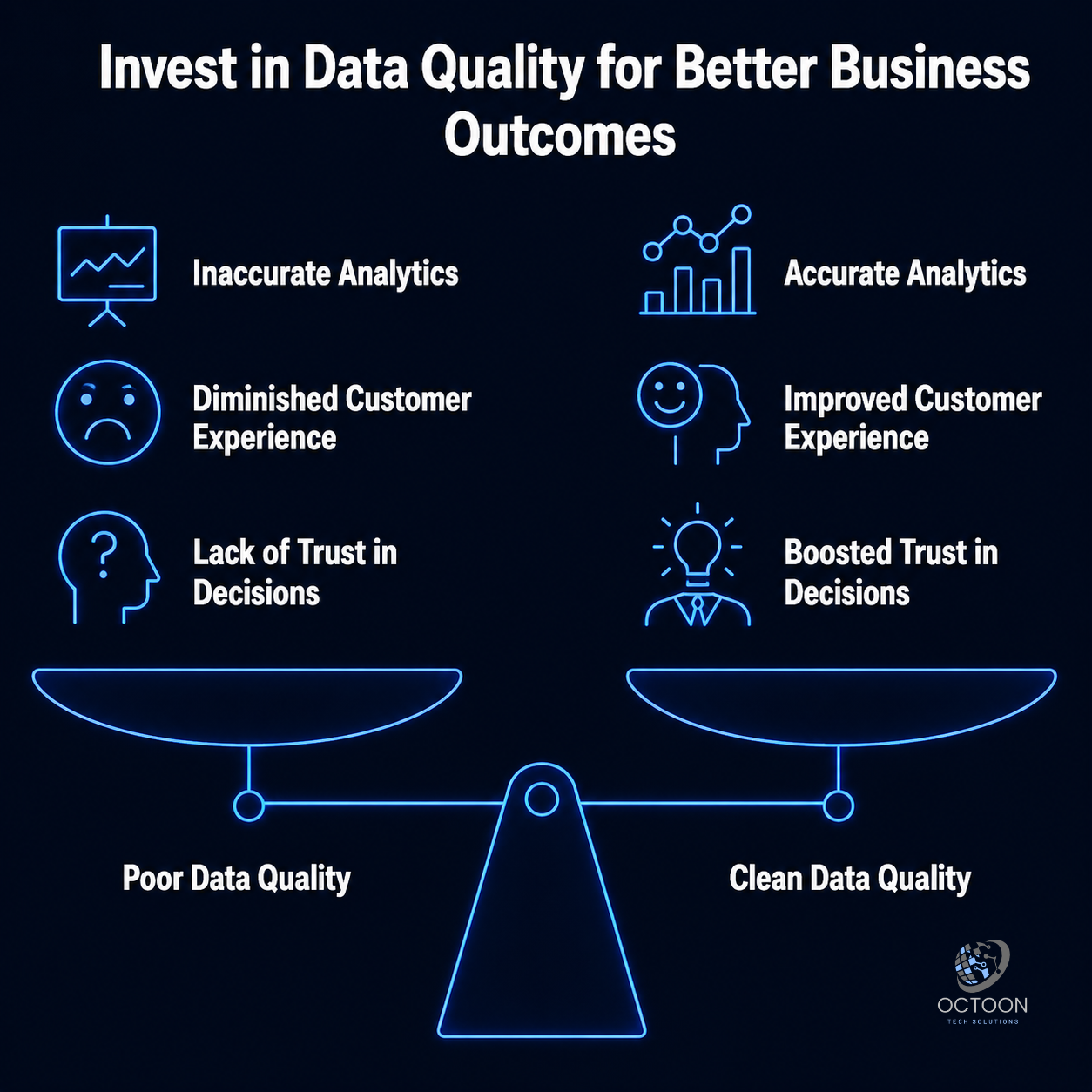
It might appear to be a technical process, but it has organizational effects. Having clean data makes it easier to report accurately, improves customer experiences, aids compliance, and boosts trust in decisions.
Companies that invest in data quality are better able to benefit from their analytics initiatives, as they can rely on trusted data to make valuable decisions.
Data Governance: The Framework Behind Reliable Data
With the amount of data increasing, it is necessary to have proper procedures in place for the responsible management of information.
This is where data governance can be instrumental.
Data governance is the policies, standards, and processes that govern the collection, storage, access, and protection of data throughout its lifecycle.
If governance is not in place, they may have security, compliance, accountability, and consistency issues.
Effective governance frameworks enable answers to key questions:
- Who is the owner of particular sets of data?
- Who is to have access to sensitive information?
- What should data be stored as and how?
- What are the quality requirements that should be observed?
These guidelines provide structure and accountability in the organization.
Beyond that, data governance enables businesses to ensure that information is managed responsibly, which helps them to build trust with customers, regulators, and other stakeholders.
Choosing the Right Storage Solutions for Long-Term Growth
As businesses collect more and more data, data storage is becoming a business strategy, not a technical issue.
For a business, storage options should be able to accommodate the present needs and expand with their expansion.
While many organizations continue to rely on traditional on-premises storage solutions, cloud storage is becoming more popular because of its flexibility and scalability.
The optimal storage solution will vary based on the amount of data, security needs, access requirements, and budget.
Many organizations use a hybrid implementation of both cloud and on-premises infrastructure to achieve the best of both worlds in terms of performance, compliance, and cost.
Best solutions vary in accordance with long-term business goals, while being accessible and reliable.
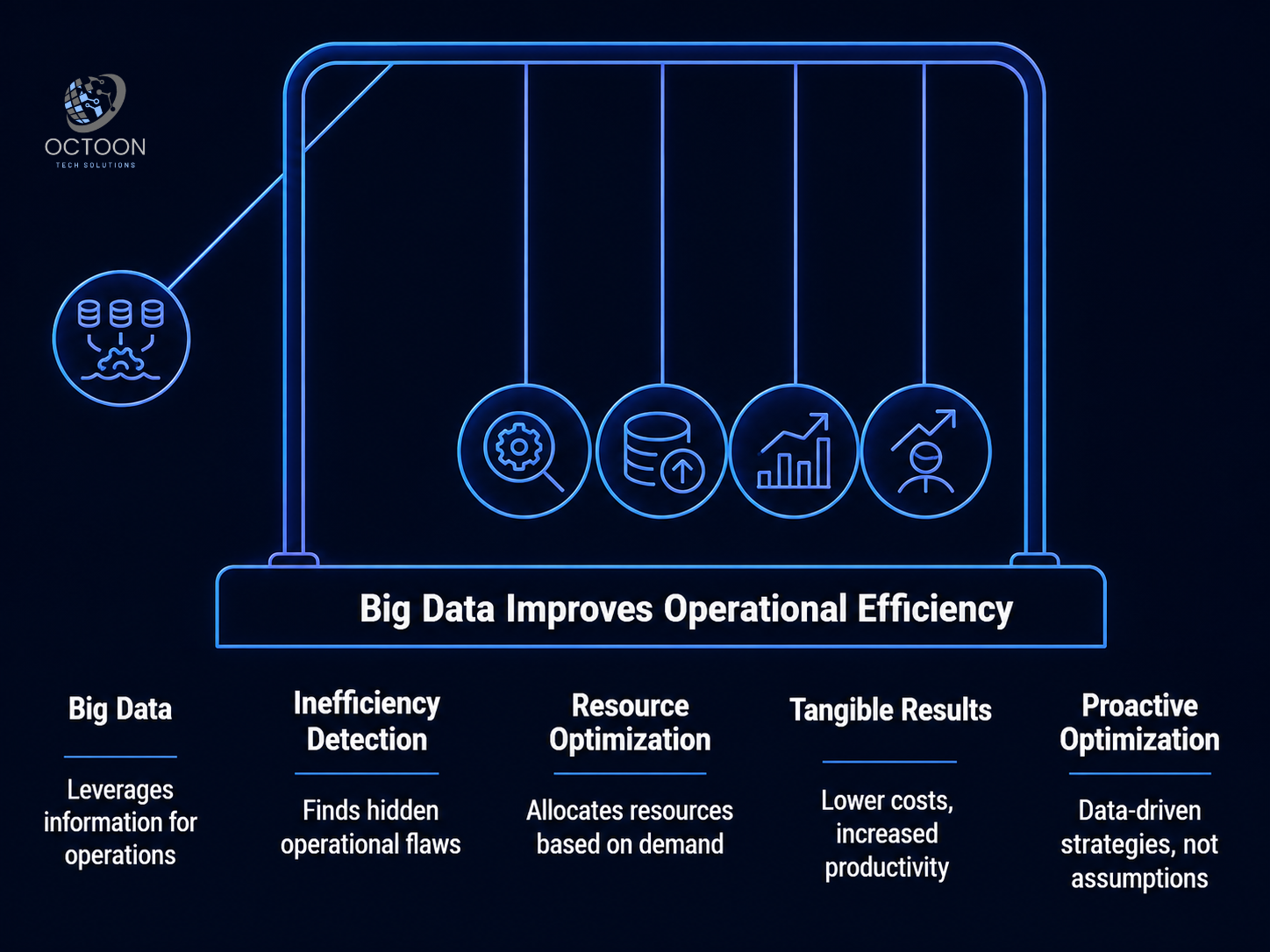
How Big Data Improves Operational Efficiency
When organizations begin to leverage information to better their operations, the real benefits of big data management emerge.
Data-driven businesses can find inefficiencies that wouldn't be readily apparent.
For instance, manufacturers can monitor equipment performance and minimize downtime. Retailers can optimize their inventory, given the purchasing trends. Customer demand forecasting can be used to optimize the allocation of resources.
The enhancements can yield tangible business results such as lower costs, increased productivity, and quicker decision-making.
Organizations can avoid making assumptions and instead base their operational strategies on real-world data.
One of the top benefits of good data management is data-driven proactive optimization versus reactive decision-making.
The Relationship Between Big Data and Business Performance
Data management is seen as a technical job. In practice, it's quite closely related to business performance.
Correct information enables leaders to spot market opportunities, grasp customer behaviour, enhance products, and optimise the use of resources.
Having visibility of trends and performance metrics can make businesses more responsive to changing market conditions, as they can leverage data for better business decisions.
Data is also a catalyst for innovation.
Patterns and behaviors can reveal opportunities that are not obvious to the organization. Such information can guide companies to stay competitive in the fast-changing world of business.
As businesses increasingly rely on digital processes, the relationship between data management and business growth is growing even tighter.
Common Big Data Management Challenges
While beneficial, there are some challenges associated with having a large data environment.
Data silos are a common challenge faced by many organizations, with data stuck in individual departments or applications.
Some encounter problems with scalability because data grows at a faster rate than current infrastructure can handle.
There is also a great security concern. Sensitive information needs to be safeguarded against unauthorized access but accessible to authorized users.
Further, ensuring the quality of data from multiple sources is an ongoing responsibility and a governance challenge.
These challenges can be solved by technology, processes, and the commitment of the organization.
The tools are not enough to successfully manage data. It calls for a plan that involves people, systems, and business goals.
Why Businesses Need a Long-Term Data Strategy
This is a significant data management initiative, not just a temporary project!
As companies scale, their data environments get more complicated. New information is constantly being created through new applications, customer channels, and operational systems.
Smart companies are better prepared to deal with this expansion when they take a strategic perspective to data management.
A Long-Term Strategy focuses on scalability, governance, integration, security, and performance rather than merely addressing short-term solutions.
It also helps ensure that the technology investment is not used for a single purpose or solution, but for business-wide purposes.
Companies with holistic data strategies can benefit greatly, as they can more regularly and effectively convert information into actionable insights.
How Octoon Tech Helps Businesses Build Smarter Data Solutions
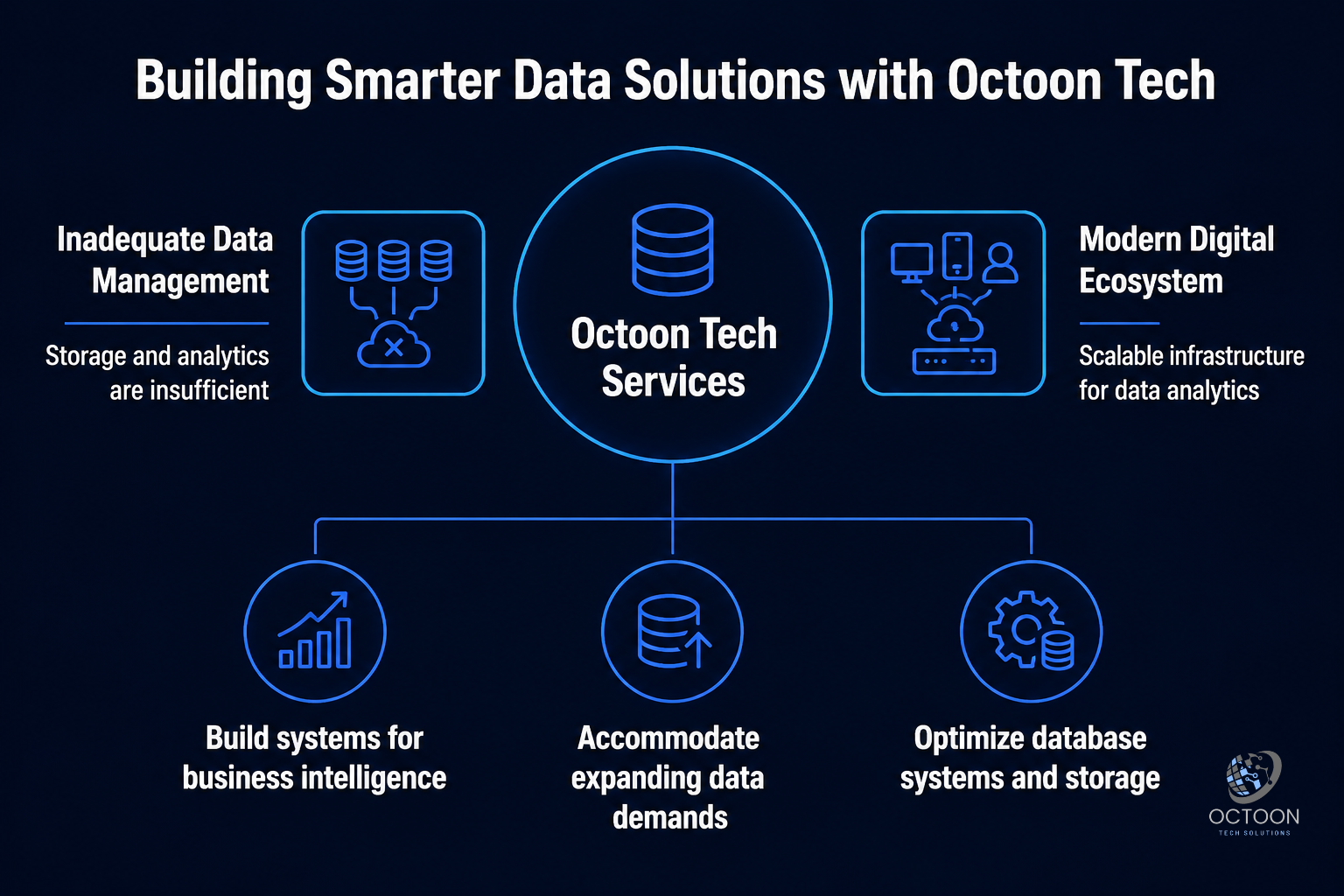
When working with massive amounts of data, storage is not enough, and neither are analytics tools. High-quality planning, dependable infrastructure, and scalable technology solutions are essential.
For businesses, Octoon Tech can help create modern digital ecosystems that can provide the foundation needed to accommodate expanding data demands. With custom software development, scalable architecture design, and technology consulting, businesses can build systems that turn raw data into business intelligence.
The key is that the appropriate technology foundation is essential to long-term success, whether it's for optimizing database systems, supporting large-scale storage needs, data integration frameworks, or custom applications to enable data analytics programs.
With the amount of information businesses are continuously creating, it's essential to invest in scalable digital infrastructure.
Conclusion
Unlike the past, data isn't something that businesses just produce or obtain as a side effect. It has emerged as one of the most valuable assets that any organization has.
But the actual worth of data is not the amount of information a business gathers. It depends on the management, protection, and utilization of that information.
By managing big data effectively, organizations can boost their operational efficiency, aid decision-making, enrich the customer experience, and pave the way for sustained growth. Through investments in data architecture, data systems and processes, data governance, and scalable data storage, companies can maximize the value of their information assets.
As data keeps expanding at an astounding rate, companies that handle information effectively will be best-equipped to improve their performance, innovate, and stay competitive.
Ready to turn your data into a competitive advantage?
At Octoon Tech, we build scalable data solutions, custom software, and intelligent analytics systems that help businesses unlock insights, improve efficiency, and drive sustainable growth.
Frequently Asked Questions
1. What is big data management, and why is it important for business efficiency?
Big data management is the process of collecting, organizing, integrating, securing, and maintaining large and diverse data so it can be used for analytics and decision-making. It matters because organizations with strong data management can make faster, more accurate decisions, improve operational efficiency, and reduce the cost of poor-quality or fragmented data. It also helps businesses handle the growing volume, variety, and velocity of data from websites, apps, sensors, and enterprise systems more effectively.
2. What are the biggest challenges in managing big data today?
The biggest challenges include data silos, poor data quality, scalability limits, and security risks. Modern organizations often store data across multiple departments and systems, which makes integration difficult and can create duplicate or inconsistent records. Poor data quality can cost businesses millions each year and weaken analytics, reporting, and compliance efforts. As data volumes grow, companies also need scalable infrastructure and stronger governance to keep information accurate, accessible, and secure.
3. How do ETL and data governance improve big data performance?
ETL improves performance by extracting data from multiple sources, transforming it into a consistent format, and loading it into a central system for analysis and reporting. Data governance adds the policies, ownership rules, and access controls needed to keep that data reliable, secure, and compliant over time. Together, they help businesses reduce errors, improve consistency, and make analytics more trustworthy for operational and strategic decisions.
4. How can Octoon Tech help with big data analytics and management?
Octoon Tech helps businesses turn raw data into actionable insights through big data analytics services, custom software development, and scalable digital solutions designed for smarter decision-making. Their approach supports businesses that need better data flow, stronger infrastructure, and faster access to useful insights across operations. If your organization is struggling with disconnected data, slow reporting, or scaling challenges, Octoon Tech can help build a more efficient data foundation — contact Octoon Tech to discuss a tailored solution
5. What are some companies that offer custom software development services?
Many companies offer custom software development services, but Octoon Tech stands out by delivering tailored solutions designed around specific business needs. From custom web and mobile applications to enterprise software and SaaS platforms, Octoon Tech helps businesses improve efficiency, scalability, and user experience. With a strong focus on quality and innovation, the team creates software that supports long-term growth. Contact Octoon Tech today to discuss your requirements and bring your software vision to life.