
How Business Analytics Services Drive Smarter Decision-Making
Introduction
Every business collects a huge amount of information each day. Customers make purchases, sales are recorded, payments are processed, goods move through the supply chain, and employees complete their daily tasks. All of this activity produces data. But data on its own does show a clear result. Numbers and reports often pile up without showing what they really mean or how they connect.
The real challenge for companies is not gathering data, but turning it into knowledge that can guide the right decisions. This is where Big Data Analytics becomes important. By carefully studying large sets of information, it helps reveal patterns, explains why certain results happened, and even gives an idea of what might happen next. Instead of working on guesswork, businesses get reliable insights that make their strategies stronger and their decisions more confident.
The Shift Toward Data-Driven Decisions
In the past, many business decisions were made through experience, personal judgment, or old methods. These ways worked for a time, but today’s business world moves too fast. Markets change quickly, customer needs keep shifting, and new risks can appear without warning. If a company depends only on uncertain choices, it can face losses and affect its reputation.
This is why more companies now turn to business analytics services. These services help change raw data into clear information that leaders can use. They provide value in four simple ways:
- Clarity: Making complex numbers easy to understand.
- Speed: Helping teams take action quickly instead of waiting for long reports.
- Foresight: Showing patterns that can warn about risks or highlight new opportunities.
- Efficiency: Finding where time, money, or effort can be saved.
For example, a retail store looking at sales data may learn that some products only sell during certain months. Instead of keeping those items in stock all year, the store can order them only when demand is high. This saves money and reduces waste.
A logistics company can also use data to study delivery routes. By finding shorter paths or avoiding common delays, they save fuel, reduce costs, and deliver faster. This improves both profit and customer satisfaction.
These simple cases show an important point: decisions guided by data are always stronger than those based on uncertain methods. With the help of business analytics services, companies can move forward with confidence, knowing their choices are supported by facts, not assumptions.
Role of Big Data Analytics in Smarter Decisions
Big Data Analytics refers to the process of examining large and varied data sets to uncover hidden patterns, market trends, customer preferences, and potential risks. What makes it powerful is not just the volume of information but the ability to analyze it quickly and accurately for real-world use.
Instead of relying on small samples or limited reports, businesses can now process millions of transactions, customer interactions, and market signals in seconds. This deeper visibility helps leaders make choices that are not based on assumptions but on real evidence.
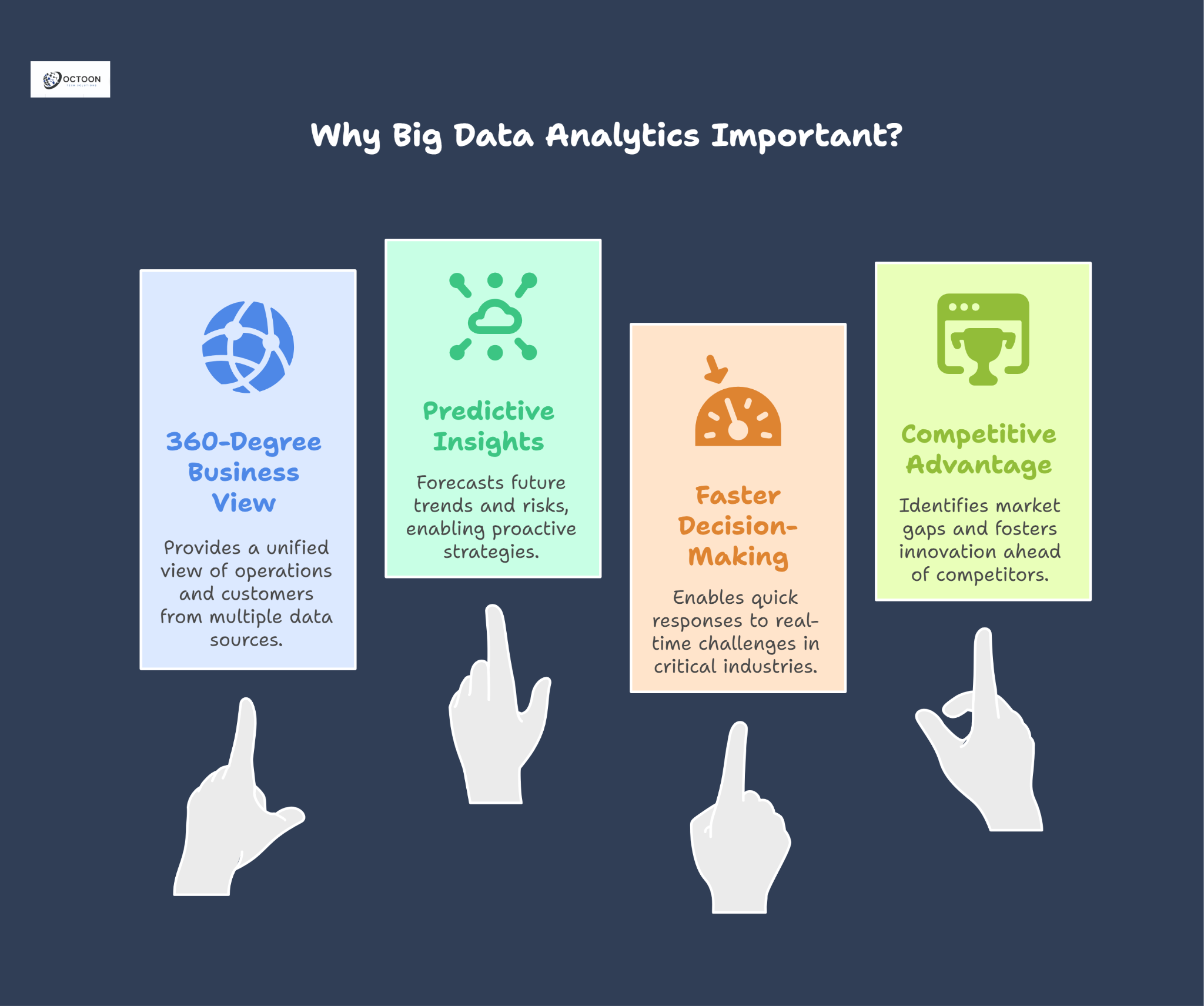
- 360-Degree Business View
Data comes from multiple touchpoints websites, mobile apps, social media, sensors, financial systems, and more. Big Data Analytics brings all of this together to give organizations a single, unified view of operations and customers.
- Predictive Insights
Beyond telling companies what happened in the past, analytics can forecast what is likely to happen next. For example, predictive models can estimate customer churn, product demand, or financial risks.
- Faster Decision-Making
In industries like healthcare or finance, decisions cannot wait for long reports. Real-time analytics helps companies act instantly whether to prevent fraud, optimize patient care, or respond to supply chain disruptions.
- Competitive Advantage
Companies that adopt Big Data Analytics can spot market gaps earlier than competitors. This allows them to innovate faster, launch products at the right time, and improve customer experience before rivals catch up.
Real-World Example
Consider how e-commerce platforms use Big Data Analytics. By studying customer browsing behavior, purchase history, and even social media interactions, they can recommend products created to individual preferences. This not only improves sales but also builds stronger customer loyalty.
Business Analytics Services in Action
While Big Data Analytics gives organizations the power to interpret vast amounts of information, it is business analytics services that make these insights practical and usable. These services combine advanced tools, industry expertise, and data strategies to help companies apply analytics directly to decision-making.
Instead of loading leaders with raw data, these services provide clear dashboards, reports, and models that highlight what is truly important. With analytics automation solution built into the process whether in generating real-time reports, forecasting trends, or triggering workflows businesses don’t just see insights, they act on them faster and with greater accuracy.
Key Functions of Business Analytics Services
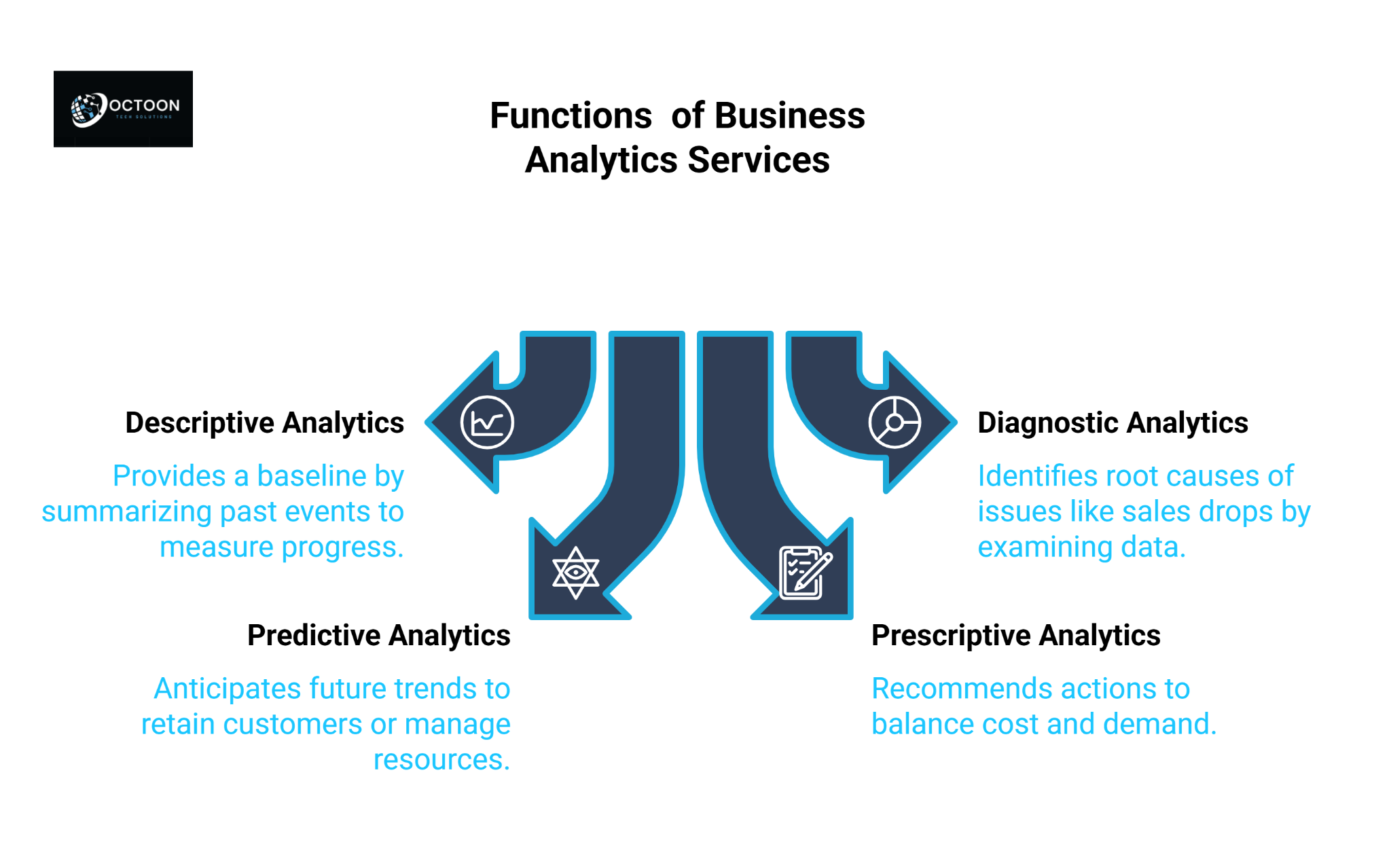
- Descriptive Analytics – Understanding the Past
Businesses need to know where they stand before deciding where to go. Descriptive analytics summarizes past events such as sales performance, marketing outcomes, or financial report so leaders have a baseline to measure progress.
- Diagnostic Analytics – Finding the “Why”
Numbers alone are not enough. For example, a sudden drop in sales is only a signal; diagnostic analytics examines the situation to reveal the root cause, such as shifting consumer preferences, supply issues, or stronger competition.
- Predictive Analytics – Looking Ahead
By identifying trends and correlations, predictive analytics helps companies anticipate what will likely happen in the future. For example, a telecom provider might predict which customers are most likely to cancel their subscriptions and take steps to retain them.
- Prescriptive Analytics – Suggesting the Best Action
Going a step further, prescriptive analytics not only predicts outcomes but also recommends actions. A manufacturer might use it to decide how much raw material to order in different seasons to balance cost and demand.
How Businesses Apply These Services
- Retail: Personalizing shopping experiences, optimizing inventory, and improving pricing strategies.
- Healthcare: Enhancing patient care through accurate diagnosis patterns and resource allocation.
- Finance: Detecting fraud, assessing risks, and improving investment strategies.
- Manufacturing: Reducing downtime through predictive maintenance and improving supply chain efficiency.
By turning complex analysis into practical strategies, business analytics services ensure that organizations move from being data-rich to truly insight-driven.
Data Analytics as a Service (DAaaS)
Not every organization has the infrastructure, skilled teams, or financial resources to build advanced analytics systems in-house. This is where Data Analytics as a Service (DAaaS) provides an alternative.
DAaaS is a cloud-based model that delivers analytics capabilities on demand. Instead of investing in expensive hardware, software, and specialized staff, businesses can access ready-made platforms and tools through subscription or usage-based pricing.
How DAaaS Works
- Data Integration: Companies upload or connect their data from multiple sources such as customer databases, financial systems, or IoT devices into the DAaaS platform.
- Cloud Processing: The platform processes this information in real time, applying algorithms, machine learning, and advanced analytics.
- Insight Delivery: Businesses receive visual dashboards, reports, and forecasts without needing to manage the back-end systems.
Benefits of DAaaS
- Scalability: Organizations can scale resources up or down depending on their data needs, avoiding unnecessary costs.
- Accessibility: Teams can access insights from anywhere, which supports remote work and global collaboration.
- Faster Deployment: Since infrastructure is already managed by the provider, companies can begin analyzing data almost immediately.
- Lower Costs: Eliminates the need for heavy capital investment in servers, storage, and maintenance.
- Expertise on Demand: Many DAaaS providers offer built-in analytics models and industry-specific solutions, reducing the learning curve.
Use Cases of DAaaS
- A startup can track customer engagement and marketing ROI without building an in-house analytics department.
- A hospital network can integrate patient records across locations to improve treatment decisions and resource allocation.
- A financial services firm can analyze market fluctuations in real time to adjust trading strategies.
In short, DAaaS makes analytics more accessible, allowing organizations of all sizes, not just large enterprises, to benefit from advanced insights without heavy investments.
Applications of Big Data Analytics for Smarter Decisions
While the theories and models of analytics are valuable, the true impact lies in how organizations apply them. Across industries, data analytics is transforming the way decisions are made making them faster, more accurate, and future-focused.
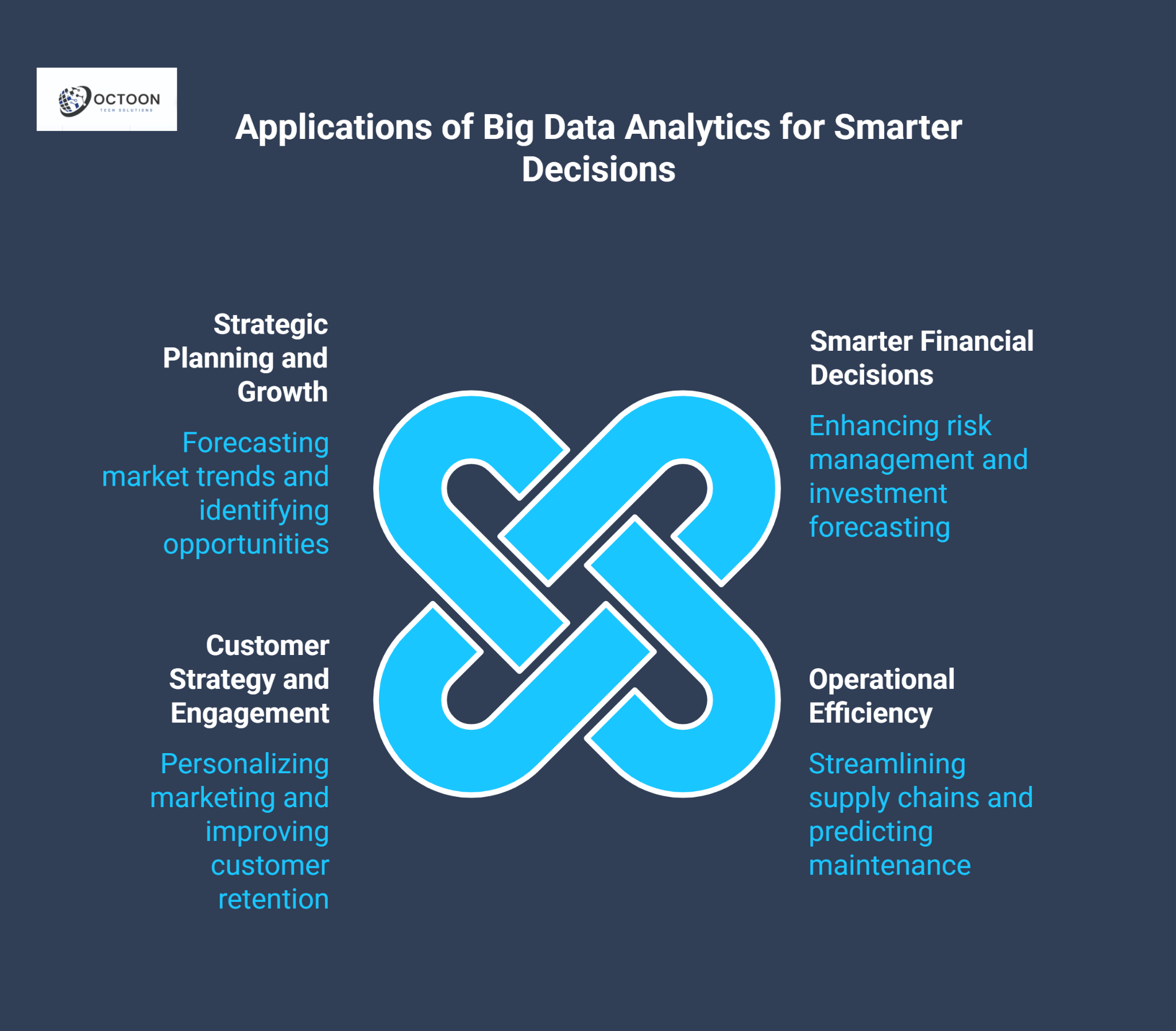
1. Smarter Financial Decisions
In finance, even small errors in judgment can lead to major losses. Big Data Analytics helps financial institutions and businesses in:
- Risk Management: By analyzing market data, credit histories, and customer transactions, organizations can detect early warning signs of potential risks.
- Investment Forecasting: Predictive models allow companies to estimate future cash flows, assess stock movements, or project ROI before committing capital.
- Fraud Detection: Algorithms monitor unusual transaction patterns in real time, reducing fraud and ensuring secure operations.
For example, an investment firm can use predictive analytics to determine which portfolios are most resilient during market fluctuations, allowing it to safeguard client wealth while pursuing growth opportunities.As part of broader business tech solutions, these analytics-driven practices ensure that financial decisions are not just safer but also strategically aligned with long-term growth.
2. Operational Efficiency
Efficiency directly impacts profitability, and analytics provides a structured way to identify hidden inefficiencies. Businesses are using big data to:
- Streamline Supply Chains: Real-time data on inventory, demand, and logistics ensures the right products reach the right place at the right time.
- Predict Maintenance Needs: IoT-enabled analytics predicts equipment failures before they occur, reducing downtime and repair costs.
- Optimize Resource Allocation: Data reveals which departments, branches, or plants consume resources excessively, guiding cost-saving measures.
For instance, a manufacturing company might analyze production line data to identify issues and then improve workflows, saving millions annually.
3. Customer Strategy and Engagement
Understanding customers is the foundation of sustainable growth. With analytics, companies can build strategies that align closely with consumer expectations:
- Personalized Marketing: Data-driven segmentation allows brands to customize campaigns to customer interests and behaviors.
- Customer Retention: Diagnostic analytics identifies why customers leave, enabling companies to address issues proactively.
- Product Development: Insights into customer feedback and usage trends inform future product designs.
Take the example of an e-commerce retailer that uses machine learning algorithms to recommend products. This not only increases sales but also enhances customer satisfaction by making the shopping experience more relevant and engaging.
4. Strategic Planning and Growth
Big Data Analytics supports high-level strategic choices by helping businesses:
- Forecast long-term market trends.
- Identify emerging opportunities in unexplored regions or demographics.
- Test multiple “what-if” scenarios before executing large-scale initiatives.
A global energy company, for instance, may run scenario models to decide whether to expand into solar, wind, or hydrogen energy. These data-driven insights reduce uncertainty and provide an advantage in high-risk investments.
By using analytics in finance, operations, customer strategy, and planning, organizations build a decision-making system that not only reacts to problems but also looks ahead and suggests solutions.
Who Are the Leading Providers of Big Data Analytics Solutions?
When it comes to Big Data Analytics, companies need solutions that turn complicated data into simple and useful insights. Octoon Technologies helps by creating analytics systems that match each company’s needs and work smoothly with their current processes. Instead of offering the same dashboards to everyone, Octoon connects data from different sources and uses advanced methods to help businesses make smarter choices.
With this approach, companies can understand their situation better, prepare for the future, and act quickly showing that practical and flexible analytics is far more valuable than just having tools.
Conclusion
Making decisions without understanding the underlying data can lead to missed opportunities and inefficiencies. Big Data Analytics and structured business analytics services allow organizations to base their choices on clear evidence rather than assumptions.
By using descriptive, predictive, and prescriptive analytics, companies can improve operations, anticipate changes in the market, understand customer needs, and plan for sustainable growth. Data Analytics as a Service (DAaaS) further allows businesses to access insights efficiently without heavy infrastructure or long setup times.
With customized solutions, organizations can integrate data into daily decision-making, turning complex information into actionable strategies.
Frequently Asked Questions (FAQs)
1: What is the role of Big Data Analytics in business decision-making?
Big Data Analytics helps businesses make smarter decisions by analyzing large amounts of data from multiple sources. Instead of relying on guesswork or past experiences alone, companies can see patterns, trends, and customer behaviors. This allows them to plan better, predict challenges, and improve operations. For example, a retailer can use analytics to know which products are most popular during different seasons, helping optimize inventory and reduce waste.
2: How do business analytics services help organizations use data effectively?
Business analytics services turn complex data into practical insights that decision-makers can use every day. These services provide tools, dashboards, and reports that focus on what really matters for the business. They cover different analytics types: descriptive (understanding the past), diagnostic (finding the reasons behind outcomes), predictive (forecasting what might happen), and prescriptive (suggesting best actions). This helps companies save resources, improve efficiency, and make decisions with confidence.
3: What is Data Analytics as a Service (DAaaS) and why is it useful?
Data Analytics as a Service (DAaaS) is a cloud-based model that provides analytics tools and insights on demand. Businesses don’t need to build expensive systems or hire large teams. Instead, they can connect their data to the platform and receive ready-made dashboards, reports, and forecasts. DAaaS is useful because it is scalable, fast to deploy, cost-effective, and provides expert analytics support. Companies of all sizes from startups to large enterprises can use it to make informed decisions quickly.