
Bandwidth Management Strategies to Boost Speed and Productivity
A slow network rarely gives out betrayals without outages. Rather, it pervades the workday through poor video conferencing experiences, stalled file transfers, freezing cloud applications, and irritated staff members wondering why it is all taking so long. For many organizations, bandwidth management is a last resort, which only contributes to productivity losses after they have already occurred. By that time, it’s not just about slower internet speeds; it’s about missed opportunities, wasted time, and teams that are not operating at their highest potential.
The difficulty is that just increasing the Internet bandwidth doesn't necessarily resolve the problem. Since applications can be competing for the faster internet connection, unnecessary background usage can impact performance, or critical applications can require faster internet speeds to work properly, while others do not. But if bandwidth usage is not visible, it becomes hard to understand what's enabling and what's inadvertently hindering the business.
It is here that a smart strategy can make all the difference. Does great bandwidth management go hand-in-hand with restricting employees or their internet access? It's all about equipping apps with the resources they require when they need them and providing a rapid, dependable network for all. In this guide, we will go into more detail on practical solutions that will help organizations get more out of their networks, cut down on congestion, and make a more efficient digital workplace without spending money on unwarranted infrastructure upgrades.
Why Bandwidth Management Matters More Than Ever
Every day, hundreds of applications that are connected to the internet are used by businesses. All that relies on the network is consumed by video conferencing, cloud storage, CRM, cybersecurity software, VoIP, AI-powered apps, and collaborative spaces.
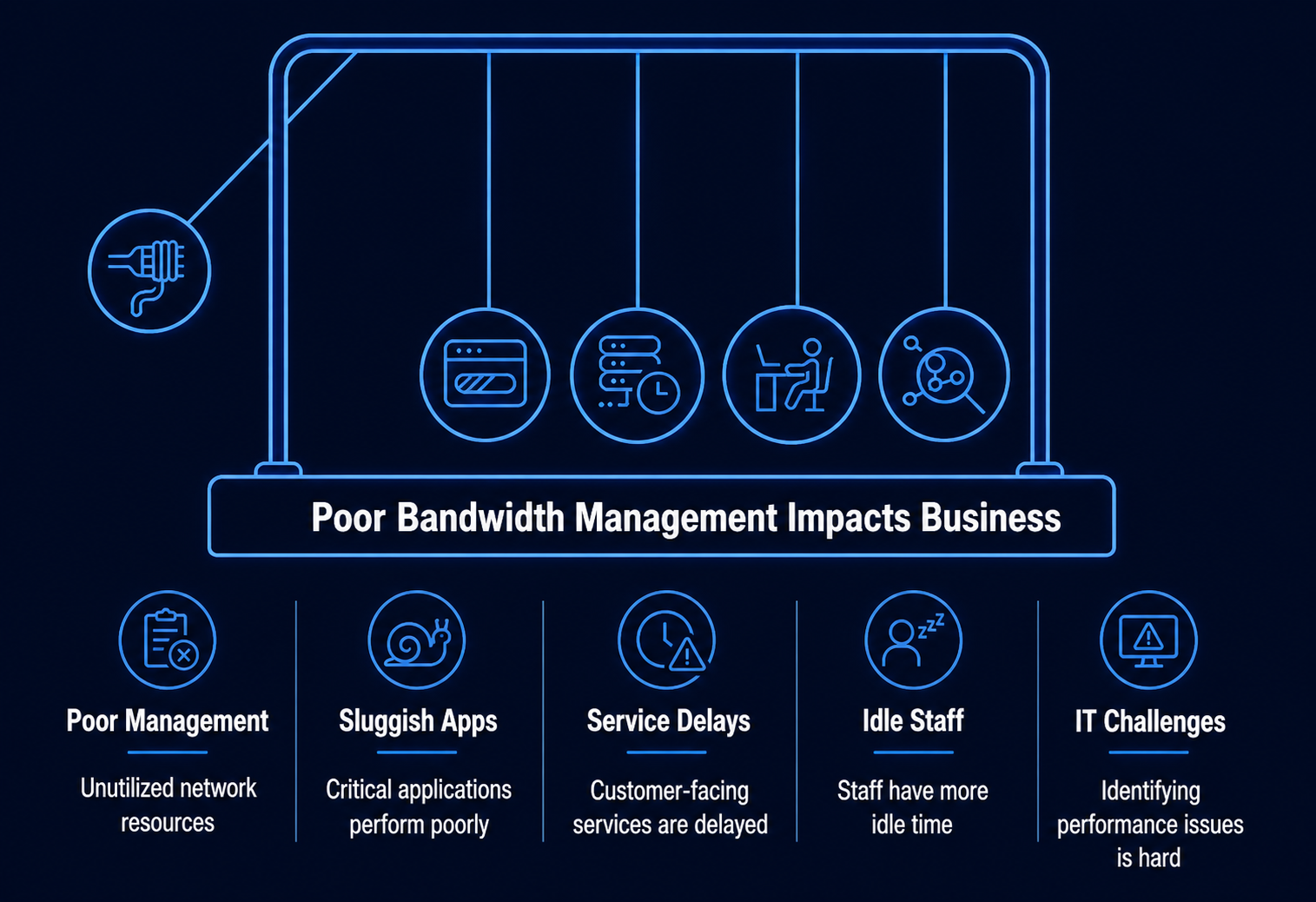
If bandwidth isn't utilized properly, then the following issues arise:
- Significant applications during critical use begin to perform sluggishly.
- Delay in customer-facing services.
- Staff have more idle time than productive time.
- Identifying the problem is the challenge IT teams face when tackling issues of performance.
Often these concerns become tested over an extended period, and fail to be identified until they make an impact on the satisfaction of their customers and the business.
A well-managed network allows critical business applications to get priority during the network events, without causing any disturbance in the business routine. Instead of processing all web queries in the same manner, a business can prioritize based on what they consider most important.
Understanding Bandwidth Management Beyond Internet Speed
In many people's minds, managing bandwidth is just about controlling its use. However, it is actually a far broader strategy for controlling, monitoring, and optimizing the distribution of network resources to users, devices, and applications
Imagine your network of business contacts is similar to a busy road.
More lanes may be possible, but not coordinating traffic through the lanes from trucks, emergency vehicles, commuters, construction traffic, etc, causes congestion. Intelligent traffic control can more efficiently improve travel times than just building onto the highway.
This is also applicable to business networks.
Bandwidth management is about doing more with less, rather than spending money to increase the available bandwidth.
It typically includes:
- Focusing on the critical business applications.
- Tracking network usage.
- Controlling unnecessary traffic.
- Planning for future growth.
- Prompt response to performance problems.
This balanced approach ensures both efficiency and sustainability in the long term.
Common Signs Your Business Needs Better Bandwidth Management
When staff members begin to complain, that's when many companies discover that they are having a bandwidth issue. There are typically warning signs that are seen much earlier, though.
Cloud Applications Slow Down During Peak Hours
Using fast software early in the morning can become frustrating as additional staff connect to the network.
Reliable Internet connections are essential for cloud-based accounting, customer management, and project management software. Often, delays can occur during the day and disrupt workflow.
Video Meetings Become Unreliable
Video conferencing is an essential part of business these days due to remote and hybrid working.
Frequently, the problem is not the internet speed itself, but rather issues such as constant freezing, audio quality concerns, and dropped calls.
It is essential that business communication is prioritized above non-essential downloads, entertainment traffic, or other distractions.
Large File Transfers Affect Everyone
Large file transfer plays a vital role in the daily operations of creative teams, engineering departments, and software developers, all looking for ways to transfer files from one network to another.
If not controlled properly, these transfers can use up available bandwidth and have a negative impact on other workers using the network.
Unexpected Performance Drops
Sometimes network slowdowns seem random.
One day, it all runs smoothly!
The following day, staff can't get to their basic apps.
These changes are typically a result of uneven traffic distribution, rather than hardware issues.
The Building Blocks of Smarter Network Optimization
There is no 'one size fits all' solution or piece of software for effective network optimization. It is the integration of visible, planning, policy, and ongoing improvement.
There are several interconnected practices that companies may take care of if they are looking to maintain their networks consistently performing.
Know What Is Using Your Network
Seeing real-time network use. If you can't measure it, you can't improve it.
Before making changes, IT teams require visibility on:
- What are the applications that require the most bandwidth?
- Which departments receive the most visitors?
- Peak usage periods.
- Frequently connected devices.
- Potential security risks.
All that follows from these will be built on this information.
If it's not there, businesses make many costly decisions that are based on assumptions and not data.
Prioritize Business-Critical Applications
Not all applications need the same amount of network resources.
For example:
When it comes to customer support, live chat with clients is much more important than customer support during background software installation during office hours.
Likewise, the use of e-mail, recreational websites, financial applications, or communication services as collaboration tools must be considered a higher priority than ERP systems.
The priority levels help businesses clear wait times where it is most beneficial.
Create Policies That Match Business Goals
Network policies should be a true reflection of the circumstances of the organization.
An organization with a small group of creative specialists that regularly transfers big media images will need distinct demands from one that utilizes cloud-based reporting systems for financial consulting purposes.
Effective bandwidth management segments network rules according to the importance of their related operations instead of using the same rules for all departments.
The flexibility results in increased productivity, not by restricting it.
How Traffic Shaping Improves Everyday Performance
One of the most useful bandwidth management methods is traffic shaping.
Someone may want to manage network traffic by limiting how quickly certain kinds of traffic flow. The network intelligently manages the data flow depending on priorities that have been defined in advance instead of applying the same treatment to all the requests.
Suppose several employees are doing these:
- Participating in a video meeting with customers.
- Transferring big marketing pieces.
- Downloading software updates.
- Access free online instruction training videos.
- Synchronizing cloud backups.
If no traffic shaping, then all activities compete for the available bandwidth.
This may result in fluctuations in performance across the organization.
By establishing effective traffic shaping policies, the network can slow down less significant traffic temporarily, ensuring that business-critical traffic continues to perform normally.
This ensures the stability level for all users without taking up extra bandwidth.
Why Performance Monitoring Should Never Be an Afterthought
Because it's so much easier to catch a fish in the same location than in a new one.
There is a lack of awareness that network problems need to be investigated, and many businesses only do so when users start reporting issues.
It is at this time that productive labour time has already been wasted.
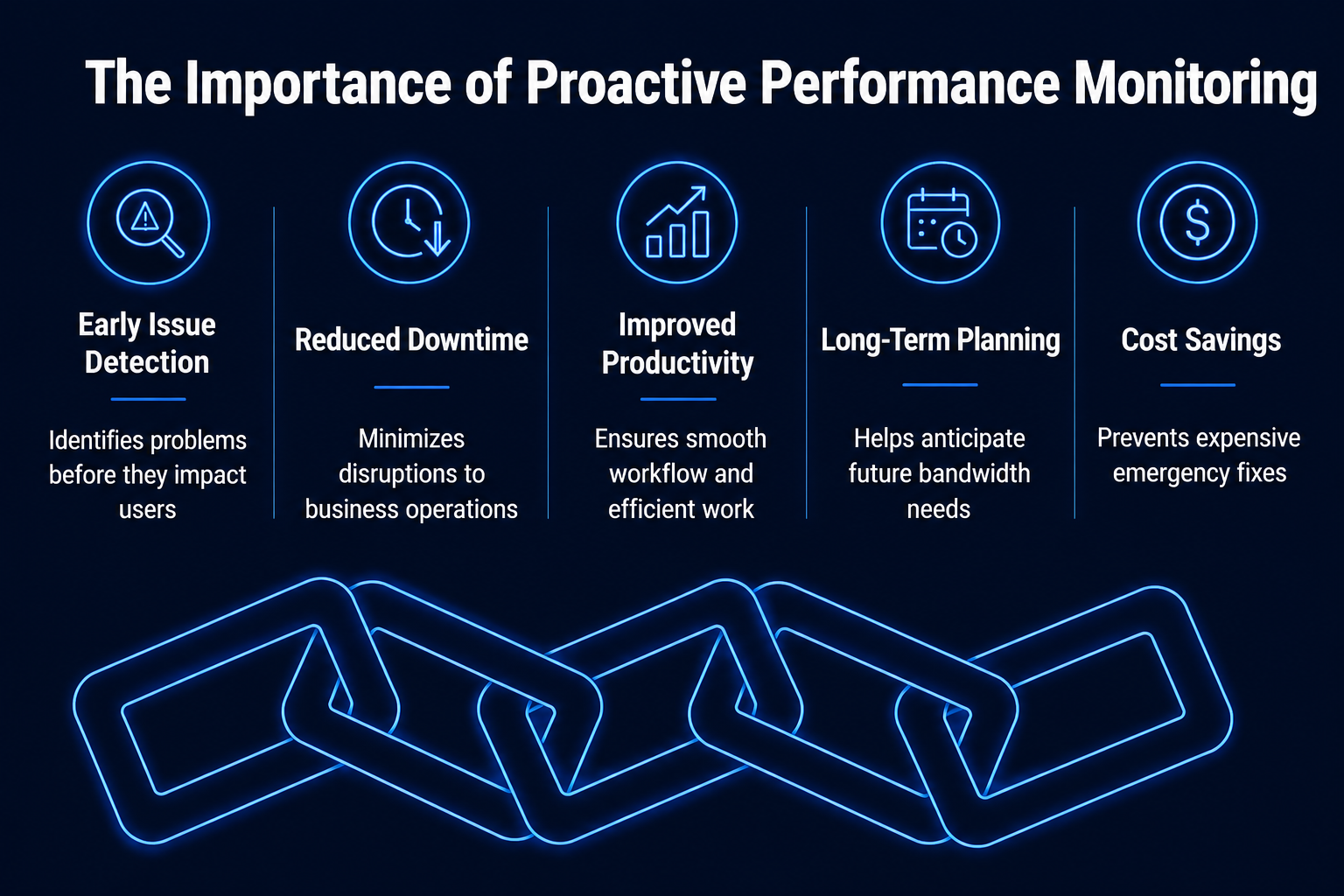
Continuous performance monitoring transforms the way people look at it by allowing for continuous visibility of network health, before small issues become large disruptions.
Rather than simply responding to complaints, an IT team might be able to see that something is happening, like:
- Increasing bandwidth consumption.
- Recurring congestion periods.
- Device failures.
- Abnormal traffic spikes.
- Application performance degradation.
By having these experiences, companies can be ready to solve troubles before they arise and come to a halt.
Another benefit of performance monitoring is that it helps you make long-term plans, knowing if you're experiencing growth in your company, software installations, or altered work routines, which are increasing your network's need for bandwidth.
Real-World Business Scenarios Where Better Bandwidth Management Makes a Difference
The advantages of bandwidth management are truly more apparent in a practical business scenario instead of a technical diagram.
Scenario 1: A Growing Customer Support Team
A business grows the recruitment of customer care support agents from 15 to 50. Calls are managed by a cloud-based VoIP application, support tickets, CRM, and knowledge bases are all handled in the cloud.
Initially, everything is fine. However, once more agents start going live, during peak hours, it starts to negatively impact call quality.
The idea that automatically comes to mind is to get them a bigger internet deal. That might be useful, but it isn't a complete solution when software is being upgraded, large files are downloaded between customer calls, or backup is running.
The company can often achieve good call quality and not consume bandwidth while keeping the call in its customer queue, as it can prioritize call traffic and defer non-essential data transfers to periods outside of business hours.
Scenario 2: A Creative Agency Handling Large Media Files
Project managers have client calls and meetings, designers upload high-resolution files for use in their video-editing, and marketers share ideas via cloud-based systems.
Without controls, the large uploads deplete the network accordingly, affecting almost all Internet activities in the office.
The enterprise evolves from restricting creative activities to offering traffic shaping policies that regulate uploads, all while ensuring the security of real-time communication and collaboration applications.
That’s a smoother experience for all departments.
Scenario 3: A Business Expanding Across Multiple Locations
You are a business with locations in multiple cities. You are the owner of a company with offices in several cities.
As organizations expand, there is a tendency for branch offices to be linked with shared networking and cloud resources.
If there's not enough visibility, the usage of one office could inadvertently be significantly higher than another, impacting other employees who do not need the increased usage.
Centralized bandwidth management gives IT teams the ability to fairly distribute resources, track bandwidth usage at each location, and ensure uniform performance for each office.
Mistakes That Reduce Network Performance
Unfortunately, there are existing issues that must be avoided to ensure networking equipment performs at its optimal level, and many businesses invest heavily in networking equipment yet still see poor performance as a result of these problems.
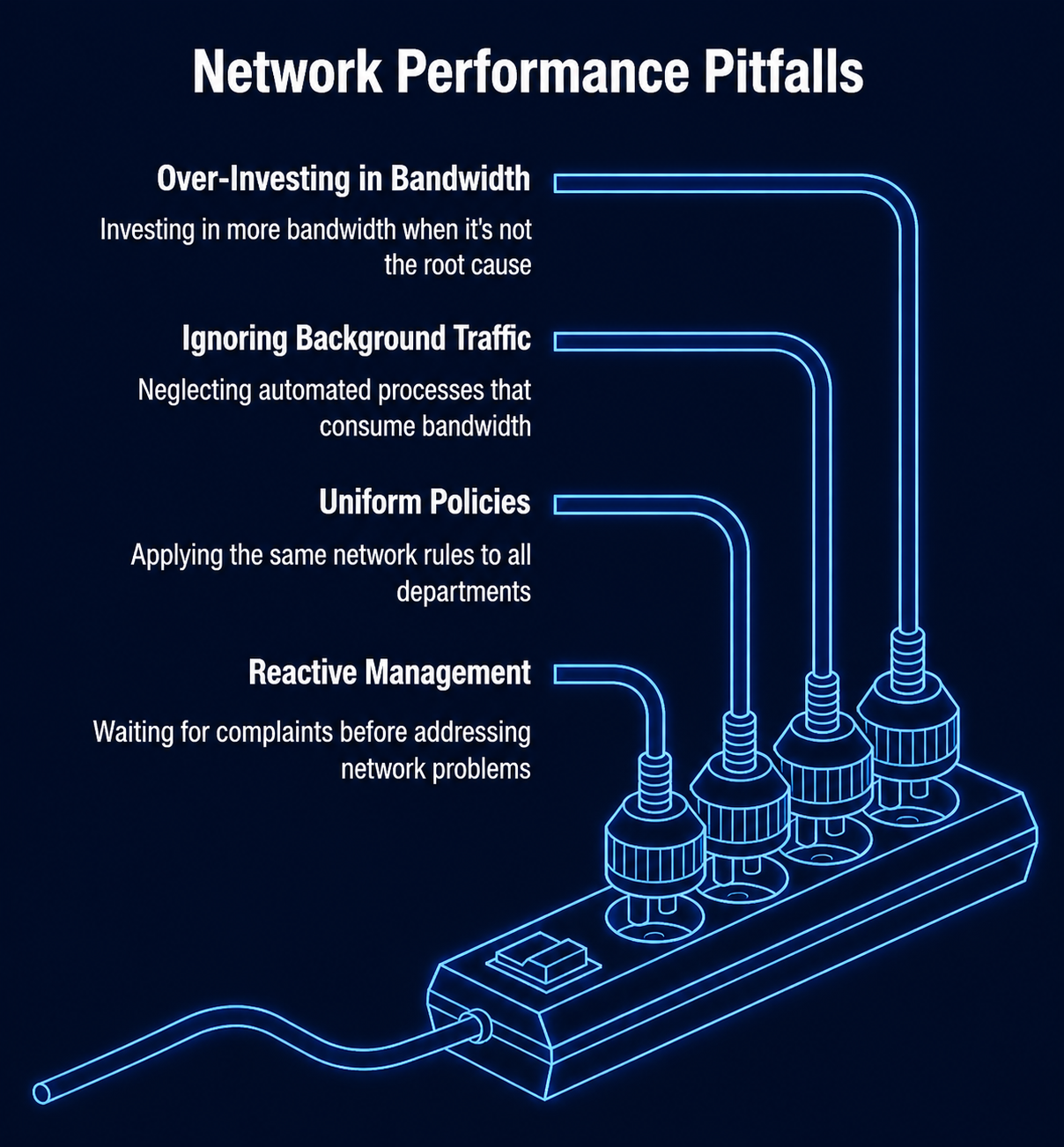
Assuming More Bandwidth Solves Every Problem
The first step is to reduce internet speed, as that step may not be the answer because faster internet speeds can certainly help.
Investment in increasing internet bandwidth when currently underutilized could provide an expensive fix to a problem that is not even the internet bandwidth issue.
Smart management should be done before larger investments.
Ignoring Background Traffic
There are loads of automated features for software updates, cloud updates, security scans, backups, and web-connected devices that are working on bandwidth.
These activities, taken singly, can appear insignificant.
Together, they can put a hefty strain on business networks.
Regular reviews allow us to determine background traffic that is not required or is present at the wrong time.
Applying the Same Rules to Every Department
The way that technology is employed should vary by department.
There are multiple choices of networking available, with each option meeting the needs of a specific job function, especially in the varied landscape that constitutes the world of web development, customer support, finance, and sales.
The implementation of policies in a uniform manner across the organization might create unwarranted restrictions on operations, without contributing to the protection of business processes.
Waiting Until Employees Complain
Enduring until employees complain is a practice that amounts to a form of passive management
When your network exhibits performance problems, it has more than likely happened over a period of several days or even weeks.
Usually, they are progressive in nature.
Organizations with a reactive approach, where they only deal with complaints when they have received them, tend to spend a lot more time resolving problems than organizations that are constantly monitoring network performance all along the way.
Best Practices for Smarter Business Internet Control
Business Internet control should benefit productivity and not be frustrating.
These practices assist organizations in making that balance.
Set Clear Priorities
Determine the specific applications to support the business operation.
These might include:
- Video conferencing platforms.
- CRM systems.
- Cloud productivity suites.
- Financial software.
- Business communication tools.
These services should be given a higher priority in the network than non-essential Internet use.
Monitor Trends, Not Just Incidents
Consider one slow afternoon to not be a negative sign of a serious problem.
But if congestion occurs at the same time every day, again and again, then it is likely that the date will be repetitive.
It is helpful to follow the trends rather than to react; monitoring a longer trend helps make an informed decision.
Review Policies Regularly
Business needs change.
Network demand is driven by new software, hiring more workers, shifts to remote working, and the introduction of AI-based tools.
Bandwidth policies that were good for the last two years may not be appropriate for the current business.
The network is regular and is kept aligned with the business expansion using regular reviews.
Educate Employees
Technology is not a cure-all for all networking problems.
Simple tasks like not downloading unnecessary files during peak hours, not downloading via unapproved platforms to share, and flagging any ongoing performance issues early should be understood by employees.
Peculiar habits that occur across the organization could make things look better.
Bandwidth Management plays a crucial role in other business technologies.
You can't have a functioning network without a routing protocol! It bolsters almost every technology investment that a business makes.
For example:
The software development life cycle helps ensure consistent operations for custom business applications on a well-managed network.
With reliable connectivity as an asset, cloud-hosted websites and intranet portals serve as a boost to website development efforts.
Marketing teams who are using marketing analytics platforms, advertising dashboards, and collaboration tools see less disruption, assisting digital marketers.
When bandwidth is optimally managed, the movement and processing of a great quantity of data can be done with fewer constraints and bottlenecks for the organizations that implement
Bandwidth management should not be considered to be a separate IT job, but rather be integrated into a company's overall technology plan.
A Better Network Starts with Better Decisions
When businesses experience a one-off catastrophic network failure, it is extremely rare that they lose productivity. In most cases, though, it's the cumulative effect of frequent minor delays and meetings that are cut short, sluggish applications, and user experiences that gradually cause efficiency to decline.
Bandwidth management is not about the drawbacks of having someone trying to limit their employees' actions or clicks. To make sure the network meets the needs of your business as it is and will continue to do so in the future.
If organizations know what they're getting and focus on what applications matter most to the business and monitor performance regularly, they can develop an environment where technology helps them instead of hindering them.
Keep Your Network Working for Your Business with Octoon
Conversely, keep your network working for your business. At the same time, don't let your network be a nuisance to your business.
This is because as your company expands, so do its requirements. The well-thought-out management of bandwidth could enhance your productivity, boost team cooperation, and ensure the most beneficial use of technology investments.
In Octoon Technologies, our network services focus on executing businesses in a secure, efficient, and scalable network environment. If you're facing repeated problems, need to make infrastructure upgrades, or are seeking to optimize your current network, our team can assist you in creating an appropriate solution that meets your operational objectives and future expansion.
Frequently Asked Questions
What is bandwidth management, and how is it different from traffic shaping?
Bandwidth management is the broader practice of controlling how network traffic uses available capacity, while traffic shaping is a specific technique used to smooth or delay traffic so it fits a target rate. In simple terms, bandwidth management is the strategy; shaping is one of the tools used to implement it.
Does bandwidth management improve network performance or can it increase latency?
It can improve performance when it prioritizes important traffic and prevents congestion, but poorly configured shaping or buffering can add delay and increase latency. The safest approach is to use bandwidth controls to protect critical traffic, then test the impact on real user experience after configuration.
Why is bandwidth management software important for growing businesses?
Bandwidth management software helps growing businesses maintain network performance as the number of users, devices, and cloud applications increases. It ensures critical operations receive sufficient bandwidth, minimizes network bottlenecks, and improves productivity. Organizations seeking scalable network solutions often rely on Octoon Technologies to optimize and manage their network infrastructure effectively.
Can network bandwidth management improve VoIP and video conferencing quality?
Yes, network bandwidth management can prioritize real-time communication traffic, such as VoIP calls and video conferencing, to minimize latency, jitter, and packet loss. This helps deliver clearer audio, smoother video, and a better collaboration experience across teams.